According to home maintenance survey data reported by Hippo Insurance, 66% of surveyed homeowners experience unexpected plumbing issues during peak summer months, with drainage failures standing as a primary driver.
Did you know that clogged drains are one of the most common plumbing problems homeowners deal with, and one of the most mishandled? Most people grab a bottle of chemical drain cleaner first, wait, nothing happens, pour another one, wait some more, and then finally Google “how to snake a drain” wondering if they’ve somehow made things worse. Spoiler: sometimes they have.
But before renting a snake, buying one, or calling anyone, it helps to know what drain snaking actually does, what it honestly cannot do, and how to read your own situation before deciding on a next step. That’s exactly what this blog is for.
What Is Drain Snaking?
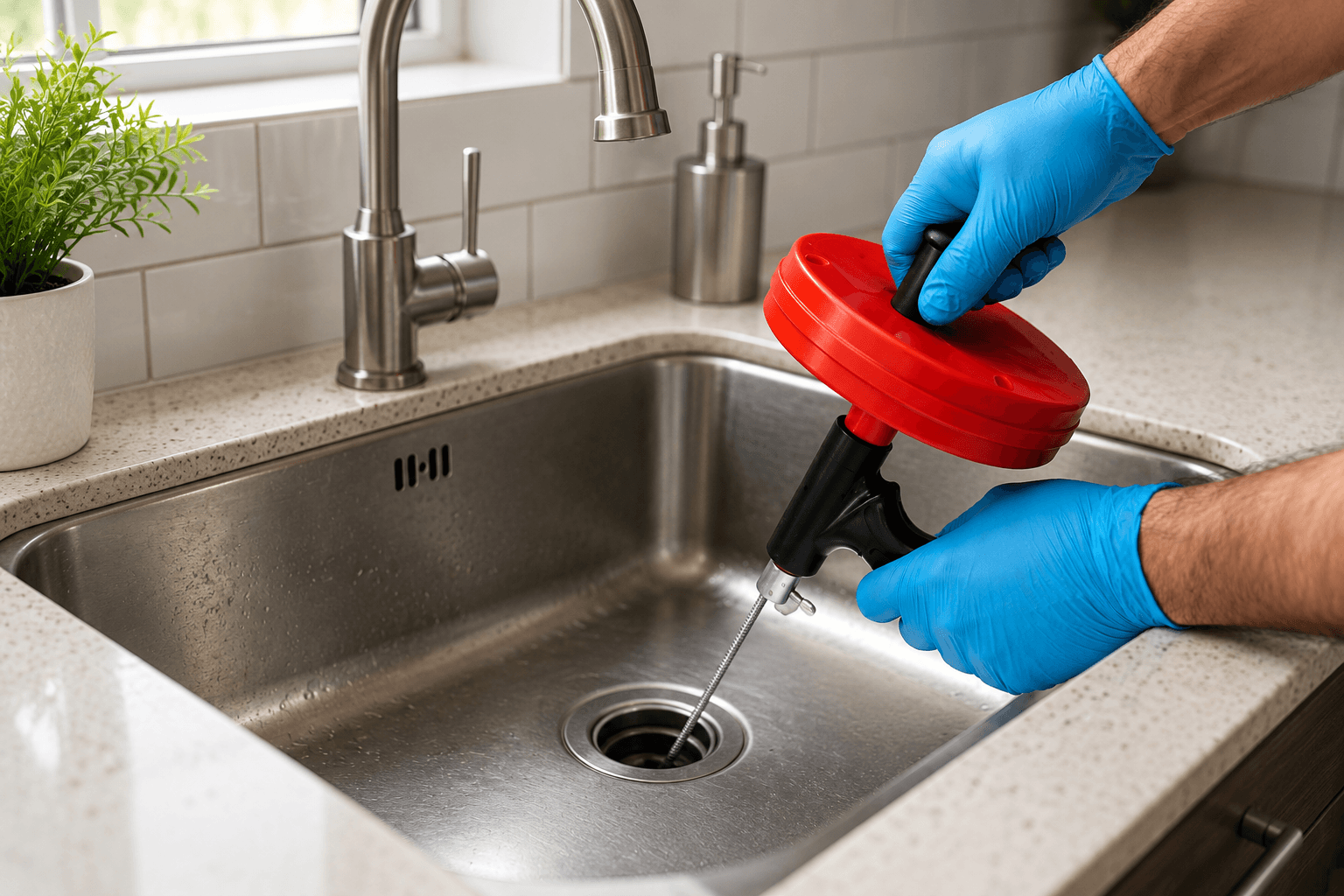
Drain snaking, also called snaking a drain or using a plumbing snake, is a way of clearing a blocked pipe using a long, flexible steel cable. One end has a coiled or corkscrew tip; the other has a hand crank or motorized drum. The cable goes into the drain, follows the bends of the pipe, and either hooks onto the blockage to pull it out or breaks it apart so water can flush it away.
The tool goes by a few names. Drain snake, plumbing snake, and drain auger are often used like they mean the same thing, and mostly they do, but there is one difference worth knowing. A drain snake is the consumer or mid-grade version: hand-cranked, usually 15 to 50 feet long, designed for household sinks, tubs, and showers.
How Does a Drain Snake Work?
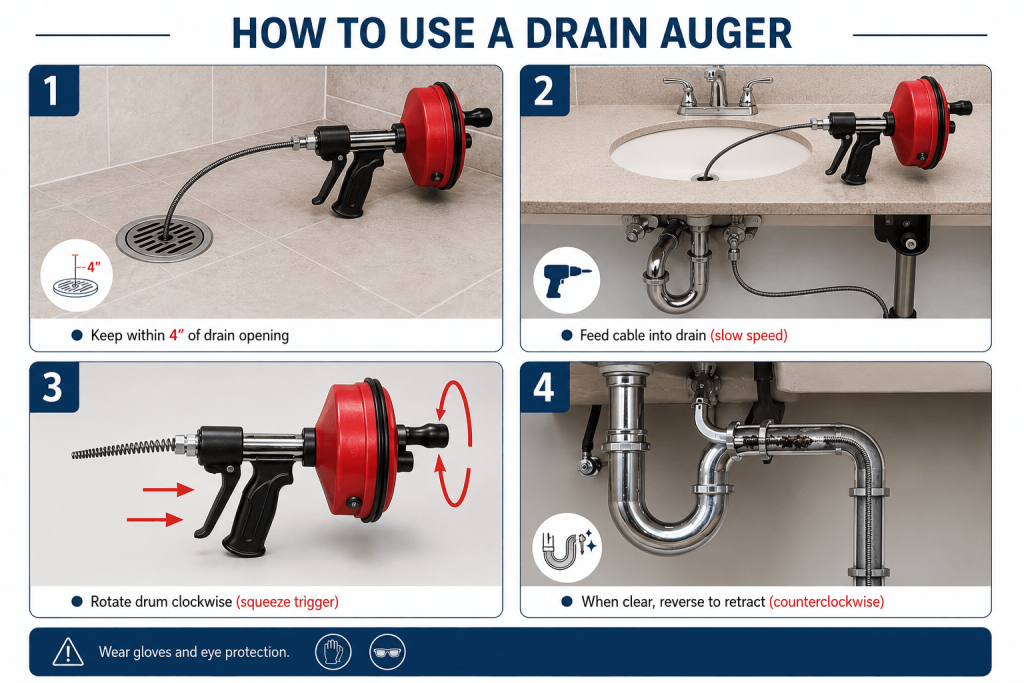
The process is simple, but a few details make a real difference.
- Insertion: The cable is fed slowly into the drain opening. Pushing too fast can pack a soft clog tighter or shove it further down the pipe, which only makes things harder.
- Engagement: Once the tip hits resistance, the handle is cranked clockwise. This spins the auger tip so it can hook into the clog, like hair or solid debris, or cut through softer buildup. Cranking counterclockwise releases the tip instead of grabbing onto anything.
- Extraction: The cable is pulled back out, hopefully bringing the clog with it or having broken it up enough to flush through. Running hot water after extraction clears out any leftover debris sitting in the pipe.
One thing most guides skip over: hitting resistance while snaking does not always mean you have found the clog.
Pipe bends feel like firm, even resistance with the cable deflecting slightly. A clog feels softer and more compressible, with a little give when pressure is applied. If the cable is just deflecting and sliding, it has hit a bend. Ease back, adjust the angle slightly, and keep feeding.
Confusing a bend for a blockage and forcing the cable through is one of the more common ways older pipes end up cracked.
Types of Drain Snakes and Which One You Actually Need
Not all snakes are built for the same job. Using the wrong one either will not work or, in some cases, will cause damage.
Tool | Best For | Typical Reach | Notes |
Handheld / Manual Snake | Bathroom sink, shower, tub | 15 to 25 ft | Good for most household clogs near the P-trap |
Toilet Auger (Closet Auger) | Toilet only | 3 to 6 ft | Rubber sleeve protects porcelain; never substitute a standard snake here |
Motorized / Electric Snake | Kitchen sink, stubborn or deeper clogs | 25 to 50 ft | More power, more risk, higher chance of pipe damage in fragile lines |
One thing that gets left out of most comparisons: pipe age matters here. If the home was built before the mid-1970s, the drain lines are likely cast iron or clay. Both materials become brittle over decades. A motorized snake can crack them, particularly when the cable hits resistance, and the operator keeps cranking. This is not meant to scare anyone off the tool. It is just a real factor that changes the risk calculation in older homes.
What Clogs Can a Plumbing Snake Actually Clear?
This is where a lot of people get burned, either by assuming snaking will fix everything or by giving up on it too early for something it would have handled just fine.
A drain snake works well for:
- Hair clogs in bathroom sinks and shower drains. The most common use case. Hair collects close to the P-trap, right where a snake reaches without trouble.
- Soap scum buildup within the first 10 to 20 feet of a pipe. The snake breaks it loose, and a flush clears it.
- Localized food debris in kitchen sink lines, particularly soft food that has not compacted into a dense mass yet.
- Small foreign objects in toilet traps, things like toys or toothbrush caps. A toilet auger can hook these out cleanly.
A drain snake has limited effectiveness on:
- Grease coating the inside of kitchen pipes. The snake punches a hole through grease but does not clean the pipe walls. That hole closes back over within weeks, which is why kitchen drain clogs keep coming back after snaking.
- Partial tree root intrusion. A snake can break off root strands that have grown into a sewer line, but roots grow back. This buys time rather than solving anything.
- Mineral scale hardened inside older galvanized or cast iron pipes. Scale resists the cable and often cannot be dislodged mechanically without putting the pipe itself at risk.
A drain snake will not help with:
- Multiple fixtures backing up at the same time. When more than one sink, tub, or toilet is slow or blocked at once, the problem is almost certainly in the main line. A snake fed from a single fixture will not reach it.
- Structural pipe damage or a collapsed section. No cable fixes a crushed or corroded pipe.
- Clogs past 50 feet from the fixture access point. Beyond that range, professional equipment is needed.
Drain Snake vs. Chemical Drain Cleaners: What People Get Wrong
This combination keeps plumbers busier than almost anything else.
Chemical drain cleaners work by dissolving organic material through a chemical reaction, usually a strong alkaline or acid-based formula. For a very shallow, very fresh clog made of soft material sitting right at the trap, they occasionally work. That is probably why people keep buying them.
The problem is everything that happens after that. Chemical cleaners dilute as they travel down the pipe. By the time they reach anything deeper than 4 or 5 feet, they often do not have enough concentration left to do anything useful. The clog that is actually causing the slow drain is usually further in than that. So the chemical sits there, partially spent, doing nothing, except now there is caustic residue coating the inside of the pipe.
This matters specifically if snaking comes next. Any plumber coming to snake a drain after chemical cleaner has been used is now working around a pipe full of hazardous material. That is not a small inconvenience. It is a genuine safety issue, and it is why most professionals ask upfront whether chemicals have gone in before they start.
There is also a longer-term concern. Regular chemical cleaner use accelerates corrosion in older pipe materials, cast iron and galvanized steel especially. Over time, the cleaner does more damage to the pipe than it ever does to the clog.
The short version: if snaking is something being considered, skip the chemical cleaner entirely. It rarely solves the problem, and it complicates whatever comes next.
When to Snake It Yourself and When to Call a Plumber
The situation is probably manageable at home if:
- Only one fixture is slow or blocked
- The drain got progressively slower before stopping, which is typical buildup behavior near the trap
- The clog is in a bathroom sink, shower, or tub, where the run to the P-trap is short and the reach is manageable
- No chemical cleaner has been used recently
- The home is post-1980 with PVC or copper drain lines
It is time to call a plumber if:
- More than one fixture is backing up at the same time. This almost always points to a main line problem.
- The same drain has clogged three or more times in a year. Snaking is treating a symptom, not a cause.
- Other drains gurgle when water runs somewhere else in the house. That sound is air being displaced in a partially blocked main line.
- The snake is not reaching the clog, keeps deflecting, or slides past without grabbing anything.
- There is a sewage smell, or water is backing up into other fixtures.
- The home is pre-1970s with clay or cast iron pipes, where the risk of pipe damage from a motorized snake is real.
Hydro-jetting is worth asking about if:
- Kitchen drain clogs keep coming back within weeks of clearing. That pattern almost always means grease on the pipe walls, and grease responds to hydro-jetting rather than mechanical snaking.
- A plumber’s camera finds the pipe walls are coated but structurally sound.
At Sketchley and Mason, the first step when a drain issue comes in is a proper inspection, not assumptions. The team looks at what is actually going on before deciding whether professional drain cleaning with a mechanical snake is the right call, or whether the situation has moved past that. For older Simi Valley homes with clay or cast iron sewer lines, annual sewer line cleaning is recommended as routine maintenance specifically because root intrusion in those pipe types is so common. A 30-day limited warranty backs most sewer cleaning work.
When a drain issue turns out to be deeper than it looks on the surface, hydro-jetting and video camera inspections are also available as part of the drain services in Simi Valley.
Frequently Asked Questions About Drain Snaking
The terms are used interchangeably, but there is a practical difference. A drain snake is the consumer or mid-grade hand-cranked tool used for household clogs in sinks, showers, and tubs. A drain auger in the professional context is a heavy-duty motorized machine built for main sewer lines with far greater cable reach. Same fundamental mechanism, completely different scale.
Consumer handheld snakes typically reach 15 to 25 feet. Mid-grade drum models go up to 50 feet. Most household clogs sit within the first 10 feet of a drain, so a standard 25-foot snake is more than adequate for typical sink and shower blockages.
Yes, if the cable is forced too quickly. Pushing too fast compacts a soft clog into something denser or drives it further down the line where it becomes harder to reach. Slow and steady lets the auger tip do the actual work.
It can, particularly in homes with older pipe materials. Cast iron and clay pipes that have been in place for 50-plus years are more brittle than most people expect. A motorized snake driven into a partial blockage in one of those lines can crack the pipe, turning a clog into a much more expensive repair. For pre-1970s homes dealing with anything beyond a surface-level bathroom sink clog, professional assessment before snaking is the safer choice.
If the same drain clogs again within a few weeks, the snake is clearing the symptom rather than the source. Recurring kitchen drain clogs after snaking almost always indicate grease coating the pipe walls. Hydro-jetting is more effective there because it cleans the pipe surface rather than just punching through it. Recurring slow drains in an older home may point to scale buildup, deteriorating pipe walls, or early root intrusion, all of which a video camera inspection can identify accurately.
For a true localized blockage like hair, soap, or food debris sitting near the trap, a single snake typically clears it for months or longer. For systemic problems like grease buildup, root intrusion, scale, or structural pipe issues, snaking buys time at best. The real fix for those situations is identifying and addressing the underlying cause, which usually means professional inspection rather than another pass with the cable.