Key Takeaways
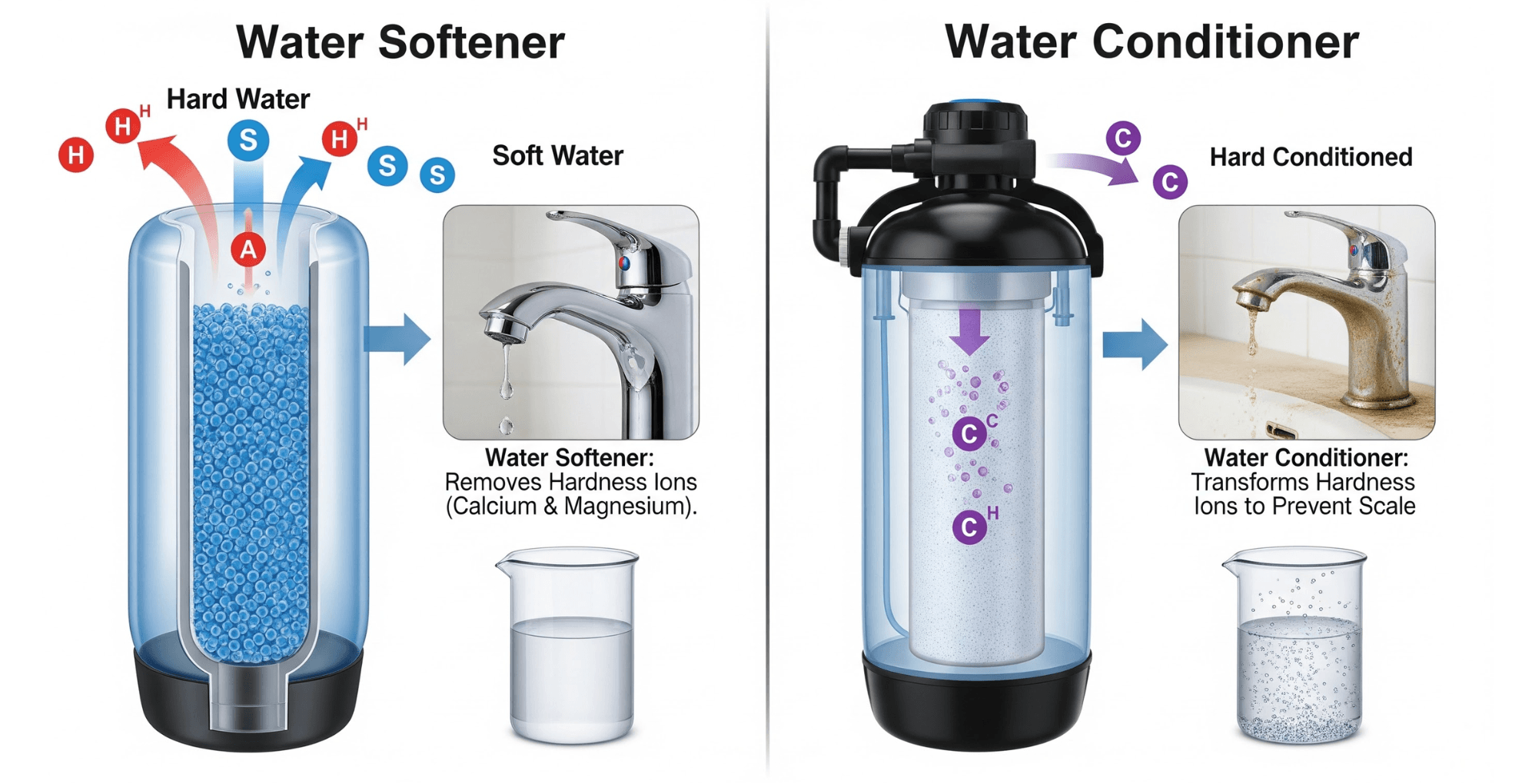
- Water softeners remove calcium and magnesium, while conditioners only change how these minerals behave.
- In Simi Valley’s hard water conditions, softeners usually provide stronger and more reliable scale protection.
- Softeners improve water feel, soap performance, and appliance lifespan, but need salt and maintenance.
- Conditioners are salt-free and low-maintenance but don’t deliver true “soft water” or full mineral removal.
- Neither system removes chlorine, so a separate filter is needed if chlorine reduction is required.
Simi Valley’s drinking water meets all federal safety standards, but it can still contain various contaminants like arsenic, chromium-6, and disinfection byproducts within legal limits. While these levels are generally considered safe for consumption, overexposure can still lead to health issues, including:
- Increased risk of certain cancers
- Potential damage to the liver and kidneys
- Skin changes such as dark patches or thickened skin
- Can contribute to heart disease risk
- Nervous system impacts, including tingling or numbness in extremities
- Can lead to digestive tract irritation
- May affect fetal development during pregnancy in high or prolonged exposure scenarios
In addition, it can lead to hard water (leaves behind solid deposits, known as scale, when heated or evaporates) issues, like:
- White scale buildup on faucets, tiles, and showerheads
- Reduced efficiency and lifespan of water heaters and appliances
- Increased soap and detergent usage
- Dry skin, dull hair, and post-shower discomfort
- Clogged pipes and reduced water flow over time
While both water softeners and water conditioners are designed to improve water quality, they address different problems. Understanding this difference is key to choosing the right system for your Simi Valley home that can significantly impact your home’s comfort, maintenance costs, and plumbing health.
In this guide, we’ll discuss water softener vs water conditioner and help you determine which option is best suited for Simi Valley homes.
What is a Water Softener?
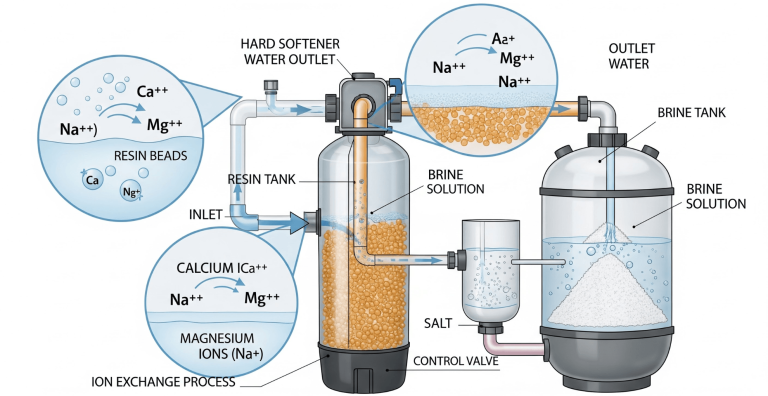
A water softener is a system designed to remove hardness-causing minerals from water through a process called ion exchange.
How does a water softener work?
1. Hard water enters the system
When water flows into the softener, it first passes through a tank filled with resin beads. These resin beads are specially designed with a negative electrical charge.
2. Ion exchange process begins
Hard water contains minerals like:
- Calcium (Ca²⁺)
- Magnesium (Mg²⁺)
These minerals are positively charged ions.
The resin beads are initially coated with sodium (Na⁺) or potassium ions, which are also positively charged but weaker.
So what happens?
✓ The resin “attracts” calcium and magnesium
✓ It “releases” sodium or potassium in exchange
This is called ion exchange. In short, the resin acts like a magnet swap system: It grabs “hardness minerals” and replaces them with “soft minerals.”
3. Softened water is delivered to your home
After ion exchange:
- Calcium and magnesium are removed
- Water now contains sodium/potassium instead
- This water no longer forms scale easily
That’s why you feel:
- “Slippery” water in showers
- Better soap lather
- No chalky residue
4. Regeneration cycle
Over time, resin beads get “full” of calcium and magnesium and stop working. So the system automatically regenerates.
During regeneration:
- A brine solution (salt + water) flows through the resin tank
- High sodium concentration forces calcium and magnesium off the beads
- These minerals are flushed out through a drain
- Resin beads are recharged with sodium again
Then the system is ready for another cycle.
Key benefits of water softeners:
- Completely removes hardness minerals
- Prevents scale buildup in pipes and appliances
- Improves soap and detergent effectiveness
- Extends the lifespan of water heaters, dishwashers, and plumbing
- Provides noticeable “soft water feel” on skin and laundry
Limitations:
- Requires regular salt refilling
- Produces wastewater during regeneration
- Higher maintenance compared to salt-free systems
What is a Water Conditioner?
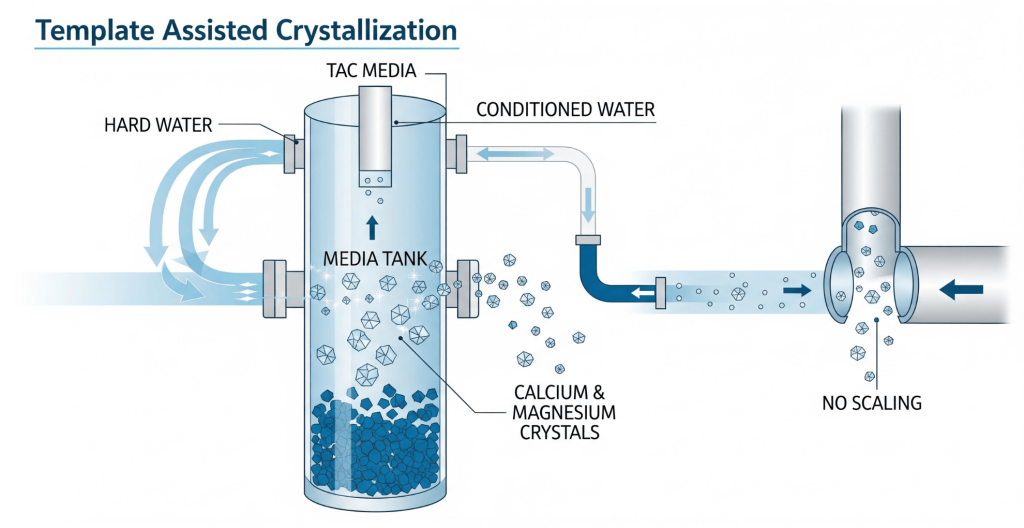
A home water conditioner is a salt-free system that does not remove hardness minerals. Instead, it changes how those minerals behave in water. Most modern water conditioning systems use a process called Template-Assisted Crystallization (TAC).
How does a water conditioner work?
1. Water flows through a special media tank
Inside the conditioner is a catalytic media (not resin). It does not exchange ions. Instead, it acts as a surface for crystal formation.
2. Hardness minerals stay in the water
Calcium and magnesium are NOT removed. So technically, the water is still “hard” in terms of mineral content.
3. Minerals are transformed into micro-crystals
As water passes through the media:
- Calcium and magnesium bind together
- They form tiny, stable crystals (like microscopic sand particles)
- These crystals are called nucleation sites
4. Crystals cannot stick to surfaces
This is the key difference.
Normally, hardness minerals:
- Stick to pipes
- Form scale on heaters
- Create white buildup
But after conditioning:
- Crystals stay suspended in water
- They flow out instead of sticking
Simple analogy:
Think of it like this:
- Hard water = sticky chalk dust that clings to surfaces
- Conditioned water = dry sand that flows and doesn’t stick
5. No regeneration needed
Unlike softeners:
- No salt is used
- No backwash cycle
- No wastewater discharge
The media lasts for years but does not “run out” in the same way resin does.
Key benefits of water conditioners:
- No salt required
- Low-maintenance system
- Eco-friendly (no brine discharge)
- Does not increase sodium levels in water
- Works continuously without regeneration cycles
Limitations:
- Does not remove calcium or magnesium
- Water does not feel “soft”
- Less effective in very high-hardness water areas
- Does not reduce total dissolved solids (TDS)
Water Softener vs Water Conditioner: Key Differences
To understand which system is better for your home in Simi Valley, it’s important to compare how each one performs in real-world conditions.
Water Softener V/S Water Conditioner: Side-by-Side Comparison
Feature | Water Softener | Water Conditioner |
Technology | Removes calcium & magnesium through ion exchange | Changes the mineral structure to prevent scaling |
Mineral removal | Yes | No |
Water feel | Soft, slippery feel | Normal water feel |
Scale prevention | Completely eliminates scale buildup | Reduces scale formation |
Maintenance | Requires salt refilling and regeneration | Very low maintenance, no salt required |
Wastewater | Produces brine discharge | No wastewater or brine |
Energy & efficiency impact | High improvement in appliance efficiency | Moderate improvement |
Best suited for | High hardness water areas | Low to moderate hardness areas |
Environmental impact | Uses salt and produces discharge | Eco-friendly, salt-free system |
Upfront cost | Higher | Moderate |
Electricity | Required | Not Required |
Long-term value | High (strong protection & savings) | Moderate (lower maintenance cost) |
Technology (Key Difference)
A water softener removes hardness minerals (calcium and magnesium) through ion exchange, replacing them with sodium or potassium ions. This means the minerals responsible for scale are completely eliminated.
A home water conditioner, however, does not remove these minerals. Instead, it changes their structure so they cannot stick to pipes and appliances.
Water Quality and Feel
Water softened by a softener feels noticeably different—it often feels smoother or “slippery” due to the absence of calcium and magnesium.
Conditioned water, on the other hand, feels more natural because the minerals remain in the water.
Note: If comfort and skin feel matter most, softeners have the advantage.
Maintenance Requirements
Water softeners require:
- Salt refilling
- Periodic regeneration cycles
- Occasional system maintenance
Water conditioners require:
- No salt
- No regeneration
- Minimal maintenance over time
Note: Conditioners are easier to maintain, but softeners provide stronger treatment performance.
Performance in Simi Valley Water Conditions
Simi Valley typically experiences moderate to high water hardness, which makes system choice especially important.
- Water softeners perform extremely well in these conditions, fully preventing scale buildup.
- Water conditioners can reduce scaling but may not fully protect plumbing and appliances in harder water situations.
For most homes in Simi Valley, softeners tend to offer more reliable long-term protection. However, make sure you check the water TDI levels in your area.
Environmental Impact
Water conditioners are generally more eco-friendly because they:
- Do not use salt
- Do not discharge brine into wastewater systems
Water softeners:
- Use salt during regeneration
- Produce wastewater discharge
However, modern high-efficiency softeners are significantly improved compared to older models.
Cost and Long-Term Value
Water softeners usually require a higher upfront investment and ongoing salt costs. However, they often provide long-term savings by:
- Reducing appliance wear and tear
- Improving energy efficiency
- Lowering soap and detergent usage
Water conditioners have lower maintenance costs but may not deliver the same level of long-term protection in high-hardness areas.
A Reddit user reported a noticeable difference in mineral buildup before and after installing a water softener. He said, “My dishwasher works 10x better now and no more white mineral residue everywhere.” |
Which One Should You Choose?
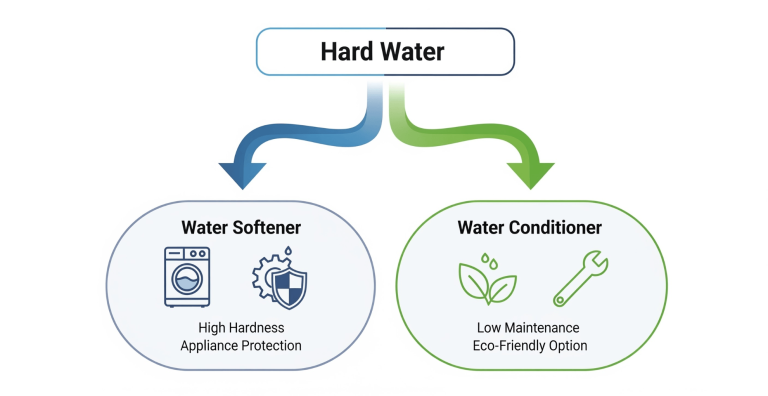
For Simi Valley homes, where hard water conditions can be moderate to high, a water softener is usually the more effective long-term solution because it removes calcium and magnesium completely. A water conditioner is a low-maintenance, salt-free alternative that helps reduce scale but does not fully remove hardness minerals.
So, it completely depends on the type of water quality your area receives.
Choose a water softener if:
- You have visible scale buildup
- You want soft skin/hair benefits
- You want maximum appliance protection
- Hard water is high (above 10 GPG)
Choose a water conditioner if:
- You want low maintenance
- You are eco-conscious (no salt discharge)
- Hardness is mild/moderate (Under 10 GPG)
- You don’t need “soft water feel.”
Final Verdict
A water softener is the more effective long-term solution for areas with moderate to high hardness levels. On the other hand, if you prefer a low-maintenance and salt-free system, a water conditioner is the best choice.
If you are struggling with hard water issues and seeking help from a professional plumbing company, you can reach out Sketchley & Mason. We can provide guidance on water softening and conditioning systems tailored to your home’s needs.
Call today or request a consultation to improve your home’s water quality and protect your plumbing system for years to come.
Frequently Asked Questions
Water containing high levels of calcium and magnesium minerals.
No. Conditioners change mineral behavior; softeners remove minerals.
In Simi Valley, a water softener typically costs between $600 and $3,000+, depending on system size, water hardness levels, and household demand. Installation usually ranges from $200 to $1,000. Homes with higher hardness levels often require higher-capacity systems for proper protection.
Water conditioners generally cost between $500 and $2,500 in the Simi Valley area. While upfront costs may be slightly lower than softeners, the overall value depends on your local water hardness and how much scale protection your home actually needs.
In most Simi Valley homes with moderate to high hardness, a water softener performs more effectively. Softeners remove calcium and magnesium completely, while conditioners only change how these minerals behave. This means softeners provide stronger and more reliable scale prevention.
Yes, water softeners can be safely used with septic systems in Simi Valley homes. However, because they discharge water during regeneration, it’s important to choose an efficient, properly sized system to avoid unnecessary water load.
No. Neither water softeners nor conditioners are designed to remove chlorine. If chlorine reduction is needed in your Simi Valley home, a separate carbon filtration system is required.
If you notice frequent white scale buildup on faucets, showerheads, or appliances, or if your water hardness measures above 10–12 GPG, a conditioner alone may not be enough. In higher-hardness areas of Simi Valley, a softener is usually the more reliable option.
Water softeners require periodic salt refilling and routine maintenance to keep performance consistent. Water conditioners are much lower maintenance since they do not use salt or regeneration cycles, making them easier to manage long-term.
For a 3,000 sq ft home, a properly sized water softener typically costs between $1,000 and $3,500+, with installation adding $300 to $1,200 depending on plumbing setup and system complexity.
A water conditioner can be worth it for homes with mild to moderate hardness or for homeowners looking for a low-maintenance, salt-free option. However, in many Simi Valley neighborhoods with higher hardness levels, water softeners tend to deliver better long-term protection.
A water softener may not be necessary if your water is already soft or if you prefer to retain natural mineral content in your drinking water. In very low-hardness areas, a softener may not provide noticeable benefits.
Common issues include salt bridging in the brine tank, resin buildup over time, improper system sizing, and reduced efficiency if not maintained properly. Most of these problems are avoidable with correct installation and periodic servicing.
No — water softeners are actually beneficial for plumbing systems in Simi Valley homes. By reducing scale buildup, they help extend the life of pipes, faucets, and water-using appliances.
No. In fact, water softeners help protect water heaters by preventing internal scale buildup. This improves heating efficiency and can extend the overall lifespan of the system, especially in hard water areas like Simi Valley.