
What You’ll Learn
|
Reviewed by the licensed plumbing team at Sketchley & Mason, Inc. — serving Simi Valley and the surrounding area since 1921, with 500+ completed local plumbing projects. Free estimates and warranties on every job we finish. Call (818) 347-5508.
The core problem, in one line: Polybutylene pipe was installed in millions of homes between 1978 and 1995, and it degrades from the inside of the pipe wall out — so a system that looks perfectly fine can rupture without any warning at all.
There’s no fixed price tag for fixing this; your actual cost depends entirely on your home’s size, how accessible your pipes are, and how much of the system needs to come out.
What follows is the straight answer on how to know if you have it, why it fails, and what to actually do about it.
What Is Polybutylene Plumbing?
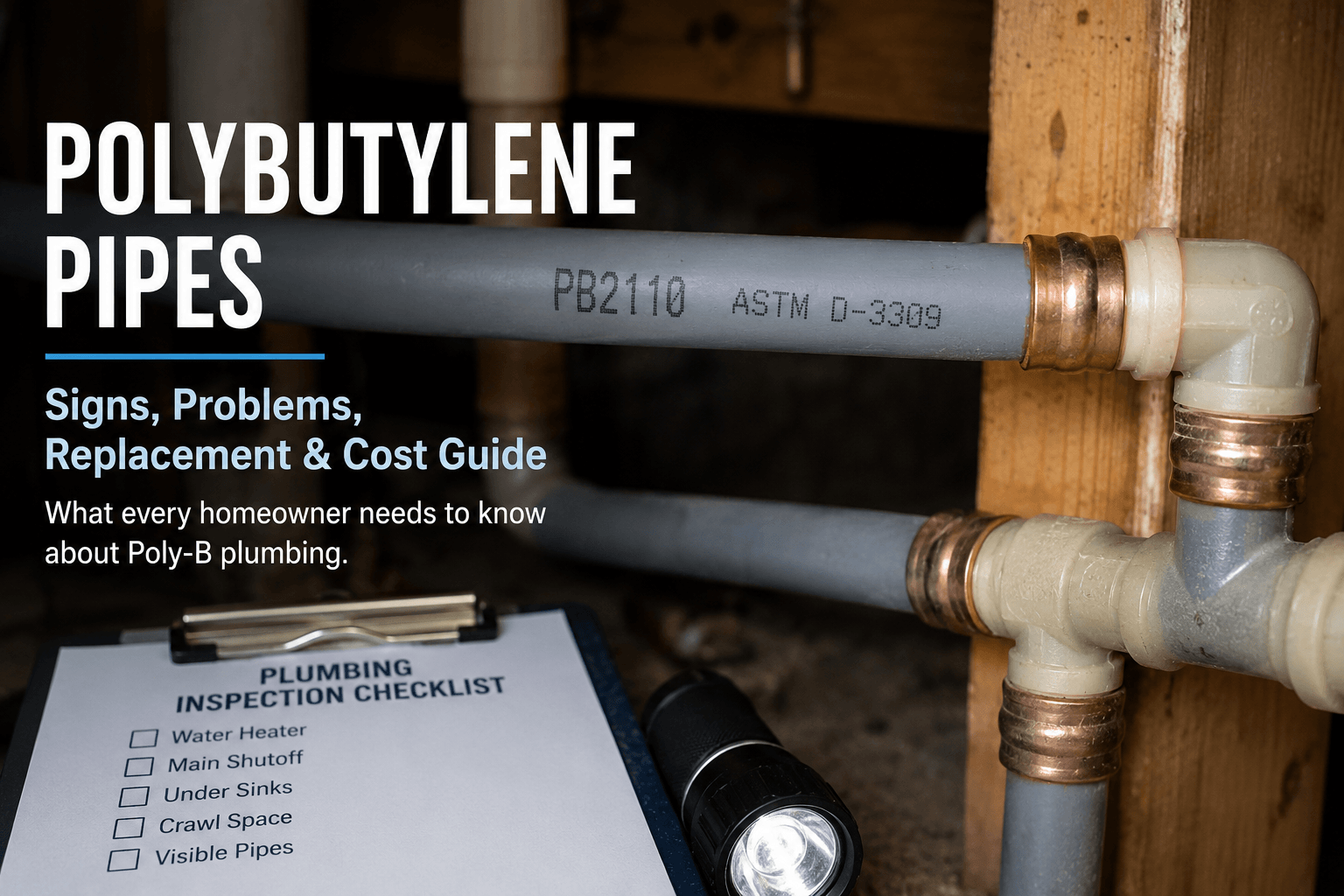
Polybutylene plumbing (often shortened to “Poly-B” or “PB”) is a flexible plastic resin pipe that manufacturers marketed as a cheaper, easier-to-install alternative to copper. It shows up as both the main water supply line into a house and the branch lines feeding sinks, tubs, and toilets.
So what are polybutylene pipes made of, exactly? They’re made from polybutylene, a thermoplastic polymer used for supply-water plumbing from about 1978 to 1995. The material is different from PVC, CPVC, or PEX. Shell Chemical became a major U.S. supplier of polybutylene resin in the late 1970s, supplying resin used to manufacture water-supply piping.
Builders used polybutylene plumbing in an estimated 6 to 10 million U.S. homes between 1978 and 1995, largely in new construction. If your home was built or replumbed in that window, there’s a real chance polybutylene is somewhere in your walls, even after later renovations.
That’s context. The part that actually matters to you as a homeowner is next.
How to Identify Polybutylene Pipes
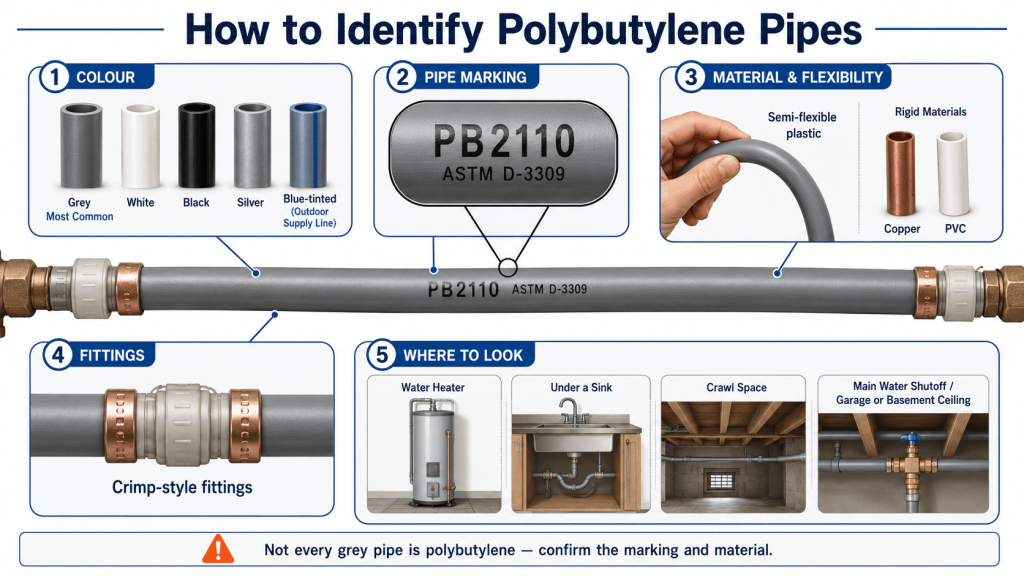
You can usually identify polybutylene pipe yourself in under ten minutes, without opening a single wall. Grab a flashlight and check your water heater, crawl space, and under-sink shutoff valves first — that’s where it’s easiest to spot.
What does polybutylene pipe look like?
- Color: A gray polybutylene pipe is the most common find, though white, black, and silver pipe also exists. A blue-tinted pipe usually marks an outdoor cold-water line.
- Material and feel: Semi-flexible plastic tubing, not rigid like PVC or copper — it bends slightly when you push on it.
- Diameter: Typically ½ inch to 1 inch across.
- Printed markings: Look for a stamp reading “PB2110“ or a reference to ASTM D-3309, the standard specification for polybutylene plastic hot- and cold-water distribution systems.
- Fittings: Plastic or copper crimp-ring fittings at each joint, rather than soldered copper joints or glued PVC fittings.
- Location: Most commonly found entering the home at the main shutoff, at the water heater, under sinks, in crawl spaces, and along basement or garage ceilings.
Are all gray pipes polybutylene?
No. Gray PVC conduit, some early CPVC, and certain electrical conduit can look similar at a glance. The PB2110 stamp and the flexible feel are your two most reliable confirmations — when in doubt, a licensed plumber can confirm it in minutes during a routine inspection.
Why Polybutylene Pipes Fail Without Warning
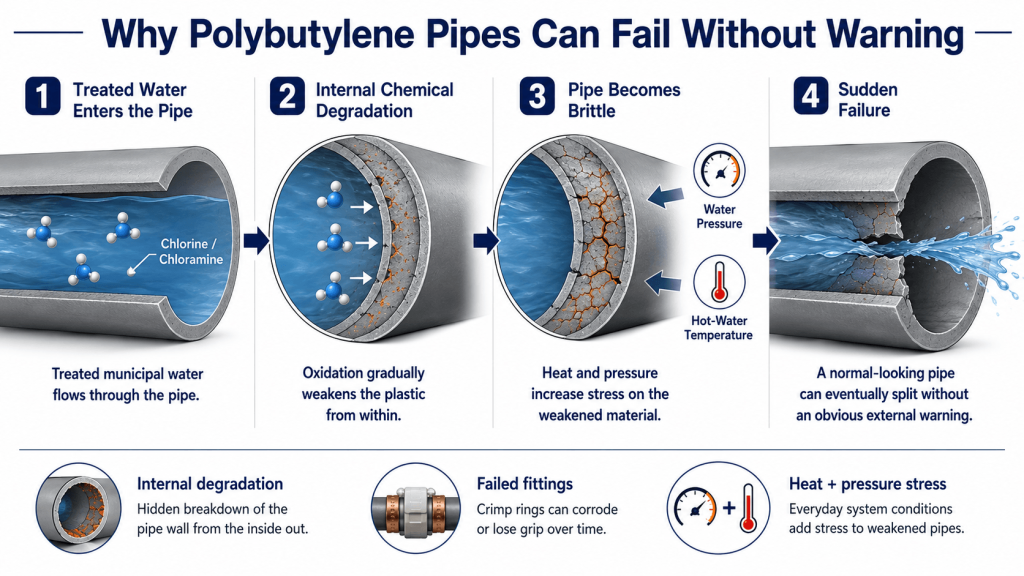
This is the actual pain point, so let’s be direct about it: polybutylene doesn’t fail like other plumbing does.
Copper corrodes visibly and slowly, giving you time to notice and act.
Polybutylene degrades from the inside of the pipe wall outward, which means a section can look completely normal right up until it splits.
The root cause is chlorine.
Municipal water treatment plants add chlorine and chloramine to kill bacteria, and those oxidants slowly react with the plastic from the inside out. Over years of exposure, that chemical reaction creates microscopic fractures and flaking inside the pipe — invisible from the outside — until the wall is too brittle to hold.
The three failure points plumbers see most
- Chlorine-driven degradation. Slowly weakens the pipe wall itself from within, regardless of installation quality.
- Failed fittings. The plastic or metal crimp connectors at each joint are often the actual point of failure, cracking or shearing off even when the pipe runs are otherwise intact.
- Heat and pressure stress. Normal household water pressure and hot-water-heater temperatures accelerate wear on plastic that’s already brittle from age and chlorine exposure.
So, is polybutylene plumbing bad? Not because it was installed poorly — the material itself reacts with treated municipal water over decades, no matter who put it in. And here’s the number that should focus your attention: even the newest polybutylene installations are now over 30 years old, well past the 10-to-15-year window in which failures typically start showing up.
Why This Matters More in Simi Valley and Ventura County
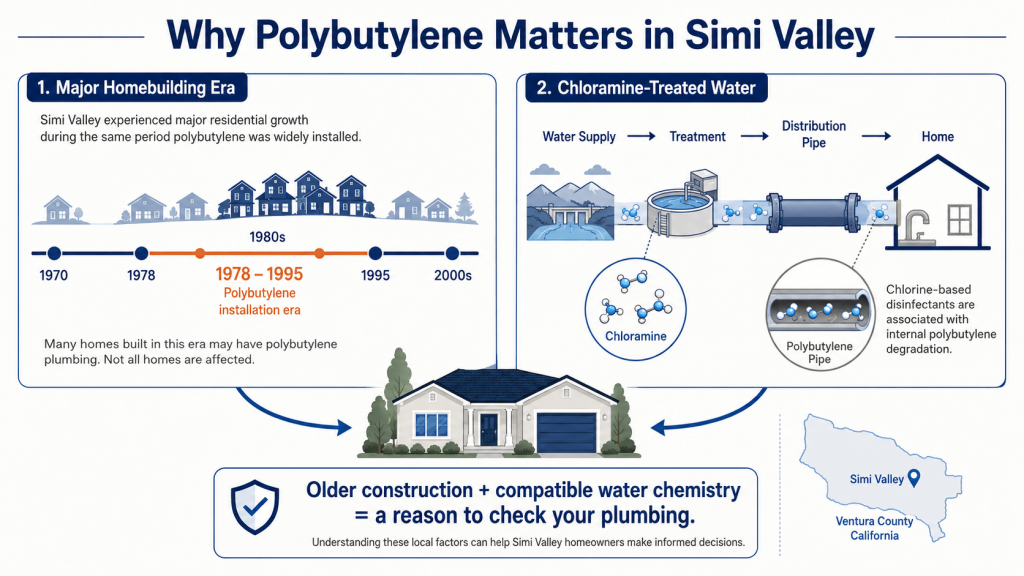
Two local facts stack the odds against Simi Valley homeowners more than the national averages suggest. Neither one is a coincidence.
First, the timing:
Simi Valley’s population exploded from roughly 60,000 in 1970 to well over 120,000 by the mid-2000s, with a major wave of tract-home construction accelerating through the 1980s once the Simi Valley Freeway opened up easier access to the San Fernando Valley.
That growth curve lines up almost exactly with the 1978-to-1995 window when builders were installing polybutylene everywhere.
Second, the water itself:
Homes here are served by imported State Water Project supply treated and delivered through Calleguas Municipal Water District, alongside local groundwater processed at the Tapo Canyon Water Treatment Plant.
Both ultimately rely on chloramine — chlorine combined with ammonia — to maintain disinfection through the distribution system, the same chlorine-based chemistry that drives polybutylene’s internal degradation described above.
Put those two facts together, and a lot of Simi Valley and greater Ventura County homes built during that boom are sitting on both the right age and the right water chemistry for polybutylene failure risk to be higher than the national picture, not lower.
Early Warning Signs of Failure
Because the damage starts inside the pipe wall, there’s rarely a slow leak that warns you first.
Watch for these signals instead:
- Frequent, unexplained water leaks in places with no obvious cause
- A sudden, noticeable drop in water pressure throughout the house
- Discolored, rust-tinted, or cloudy water coming from the tap
- An unexplained spike in your monthly water bill
- Water stains, bubbling paint, mold, or mildew on walls and ceilings near plumbing runs
- Visible flaking, dullness, or blistering on any exposed sections of gray pipe
Any one of these on its own could be something minor. Two or more together, in a home built between 1978 and 1995, is a strong enough pattern to get a professional look before it becomes a burst-pipe emergency.
Repair or Full Replacement?
This is the decision every homeowner with polybutylene eventually has to make, so here’s the direct answer:
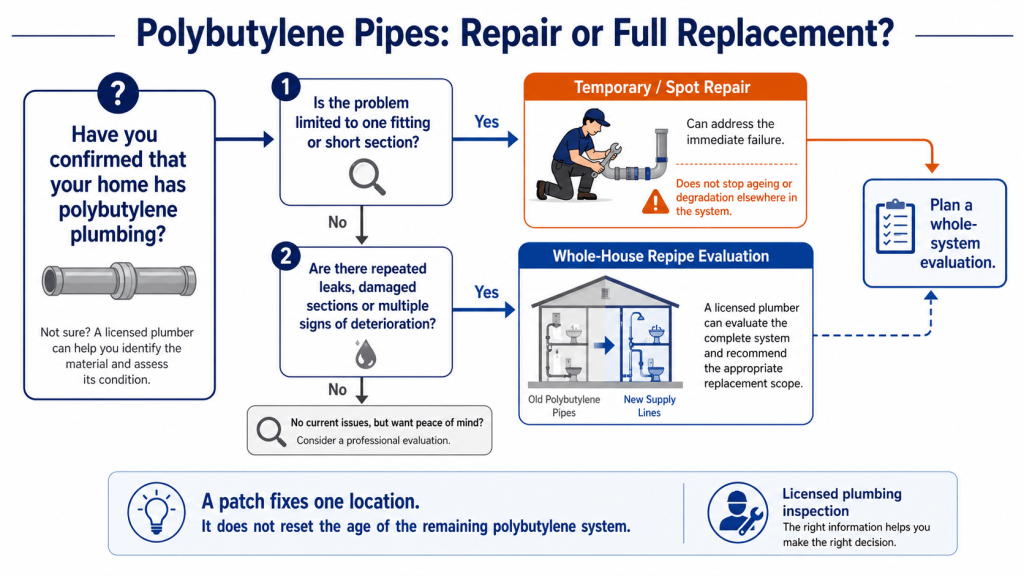
You can patch a single failed fitting or a short section as a stopgap, but patching doesn’t stop the rest of the system from degrading.
It just buys time on one spot while the rest of the pipe keeps aging on the same chemical clock.
That’s why most licensed plumbers and home inspectors recommend full replacement rather than spot repair once a home’s polybutylene system starts showing any failure at all.
What Actually Determines Your Replacement Cost
There’s no single, honest dollar figure anyone can give you without seeing your home — and any site that quotes you a flat number without an inspection is guessing.
Your polybutylene pipe replacement cost is driven entirely by a handful of real, specific factors:
| Factor | How It Moves Your Cost |
| Home size & bathroom count | More fixtures and more linear feet of pipe mean more material and labor. |
| Pipe accessibility | Pipes reachable through a crawl space or basement cost far less to replace than pipes buried in finished, multi-story walls. |
| Drywall and finish work | Every wall that has to be opened to reach a pipe run adds cutting, patching, texturing, and repainting to the job. |
| Replacement material | PEX, copper, and CPVC differ in material price and in how long each takes a crew to install. |
| Scope of the job | A single failed section costs far less to address than a full whole-house repipe. |
| Local labor rates & permits | Cost varies by region and by what your city requires for inspection and permitting. |
The only way to get an honest number is a walkthrough from a licensed local plumber who can actually see your pipe runs, your walls, and your access points. Anyone quoting a number without that step is estimating blind.
The Best Replacement Materials: PEX vs. Copper vs. CPVC
Nearly every plumber recommends PEX or copper as the replacement material, and for good reason — both have decades of a much better track record than polybutylene.
| Material | Flexibility | Typical Lifespan | Notes |
| Polybutylene (being replaced) | High | 10–15 years before failure risk rises | Discontinued since 1995; degrades from chlorine exposure |
| PEX | High | 40–50 years | Most common modern replacement; fast to install, code-approved nationwide |
| Copper | Rigid | 50+ years | Most durable option, but slower and more labor-intensive to install |
| CPVC | Rigid | 40–50 years | Durable and chlorine-resistant, though more brittle in cold conditions than PEX |
Polybutylene Pipes vs. PEX: What’s the Real Difference?
Is PEX considered polybutylene? No — and this is worth being precise about, because the two get confused constantly.
PEX (cross-linked polyethylene) is a chemically different plastic with a different molecular structure, and it doesn’t share polybutylene’s specific vulnerability to chlorine-driven internal cracking.
Both are flexible, and both install faster than rigid pipe, which is exactly why PEX gets mistaken for “the same stuff, rebranded.”
It isn’t.
PEX has passed decades of independent building-code testing that polybutylene never survived, which is the real reason it became the standard replacement rather than just a trend.
Polybutylene Pipe vs. PVC: Why They’re Not Interchangeable
PVC and polybutylene aren’t really competing for the same job in most homes.
Rigid PVC and its heat-rated cousin, CPVC, are glued at each joint rather than crimped, which makes them sturdier against the same chlorine exposure but far less forgiving in tight, twisting spaces where flexible pipe can just bend around an obstacle.
For a home that needs to weave pipe through existing framing without tearing out entire walls, that rigidity is a real drawback — which is part of why PEX, not PVC, ended up as the default swap for polybutylene in most whole-house repipes.
Bottom Line on Materials
- PEX wins on flexibility and installation speed
- Rigid PVC/CPVC wins on chemical resistance in certain applications
- Copper wins on sheer longevity
However, none of the three carry polybutylene’s specific failure history.
How Long Does Replacement Take?
For a typical single-family home, a licensed crew can often complete a whole-house PEX repipe in one to two days of active plumbing work, with drywall patching and paint touch-ups adding another day or two after that. Larger homes with more bathrooms or harder-to-reach pipe runs take longer.
Copper repipes generally take more time than PEX because copper requires soldering each joint by hand rather than crimping flexible tubing into place — one more reason PEX has become the default recommendation for polybutylene replacement jobs.
Where This Leaves You
Here’s the thing about an old plumbing system: it doesn’t actually care whether you’re paying attention to it. It just keeps aging in the walls, on its own schedule, whether you’ve thought about it or not.
The only real variable is whether you find out on your own terms, or whether a burst pipe finds out for you at two in the morning, making you call for emergency plumbing services in Simi Valley.
That’s really what this whole question comes down to. Not “is my house doomed,” but “do I know what I’m working with yet?”
Once you do, the rest stops being scary and starts being a project — one with a clear starting point, a licensed professional who can walk it with you, and an end date.
Old houses carry old decisions made by people who had no idea what thirty years of tap water would do to their choices.
That’s not a flaw in your home. It’s just a chapter that eventually needs closing, on your schedule instead of the pipe’s.
Frequently Asked Questions
Ask the seller for one of two things in writing: a full repipe completed by a licensed plumber before closing, or a credit large enough to cover the replacement yourself right after you move in. Either way, ask for documentation of the pipe's condition and get your own plumber's opinion before you finalize the ask — inspection reports flag the material, but they don't always assess how close it is to failing.
Not automatically. A system with copper (not plastic) fittings, no leak history, and a seller willing to negotiate is a very different situation than one already showing flaking or active leaks. Treat it as a real repair cost to plan for, not necessarily a reason to walk away — but don't skip getting a plumber's independent read on it before you waive the contingency.
No building code forces an existing homeowner to replace polybutylene pipe that hasn't failed. That said, given that essentially every installation is now past its typical 10-to-15-year failure window, most plumbers treat replacement as a "when," not an "if."
There isn't a meaningful "average" that applies to your specific house — it depends on your home's size, how accessible the pipes are, and how much of the system needs replacing. A licensed plumber can only give you an accurate number after seeing your home in person.
Often not fully. Many home insurers treat active polybutylene plumbing as an ongoing known risk rather than a one-time repair, and some carriers limit coverage to leaks that are sudden and accidental rather than gradual seepage.
Yes, but you have to disclose it. In California, the Real Estate Transfer Disclosure Statement (TDS) required under Civil Code Section 1102 requires sellers of most 1-to-4-unit homes to disclose known material defects, including polybutylene plumbing, even in an "as-is" sale. Buyers who find it during inspection typically ask for a full repipe before closing or a credit to cover it themselves.
Technically, some sections can be DIY'd, but a whole-house repipe involves shutting off your main water supply, cutting into walls, and passing a final plumbing inspection. Most municipalities require a licensed plumber and a permit for exactly this reason.
Ready to Stop Wondering and Get an Answer?
If you’re in Simi Valley or anywhere in the surrounding Ventura County area, Sketchley & Mason, Inc. has been solving exactly this kind of plumbing question for local families since 1921.
We’ll check your pipes, tell you honestly whether it’s polybutylene, and walk you through repair-versus-replace options based on your actual home. No guesswork, no upsell, no cost figure quoted until we’ve actually seen your pipes.
Call (818) 347-5508, or contact us for a free estimate.